

Imagine unboxing a 450 AED limited edition scent in your Dubai residence, only to find the wax surface slick with beads of oil and the wick too damp to catch a flame. It's a common frustration for collectors across the Emirates where summer humidity levels frequently climb above 60 percent. This moisture doesn't just ruin the aesthetic; it actively degrades the structural integrity of your luxury wax. You've curated your collection for its olfactory art and sculptural beauty. Seeing a premium vessel warp or lose its fragrance throw is a disappointment no connoisseur should face.
Mastering candle care in humidity is the secret to protecting your investment against the challenging Gulf climate. We'll show you how to preserve the pristine surface of your candles and ensure a powerful, clean scent throw every time you light them. From precise storage temperatures to the exact moment a professional refill service becomes necessary, this guide provides the technical expertise needed to maintain your home's sensory atmosphere. Prepare to transform your maintenance routine into a seamless part of your luxury lifestyle.
Key Takeaways
- Understand how high dew points in the Emirates affect the stability of natural soy and beeswax blends compared to traditional waxes.
- Create a precise micro-climate for your home fragrance by maintaining a specific temperature range and avoiding moisture-rich zones.
- Learn to identify "syneresis" as a sign of premium fragrance loading and how to restore your candle's aesthetic appeal through delicate blotting.
- Master candle care in humidity by perfecting the critical first burn and adjusting session lengths for the heavy Gulf air.
- Preserve the longevity of your luxury glass vessels by knowing exactly when to extinguish the final flame for safe, sustainable repurposing.
The Science of Scent: How Humidity Affects Premium Wax and Fragrance
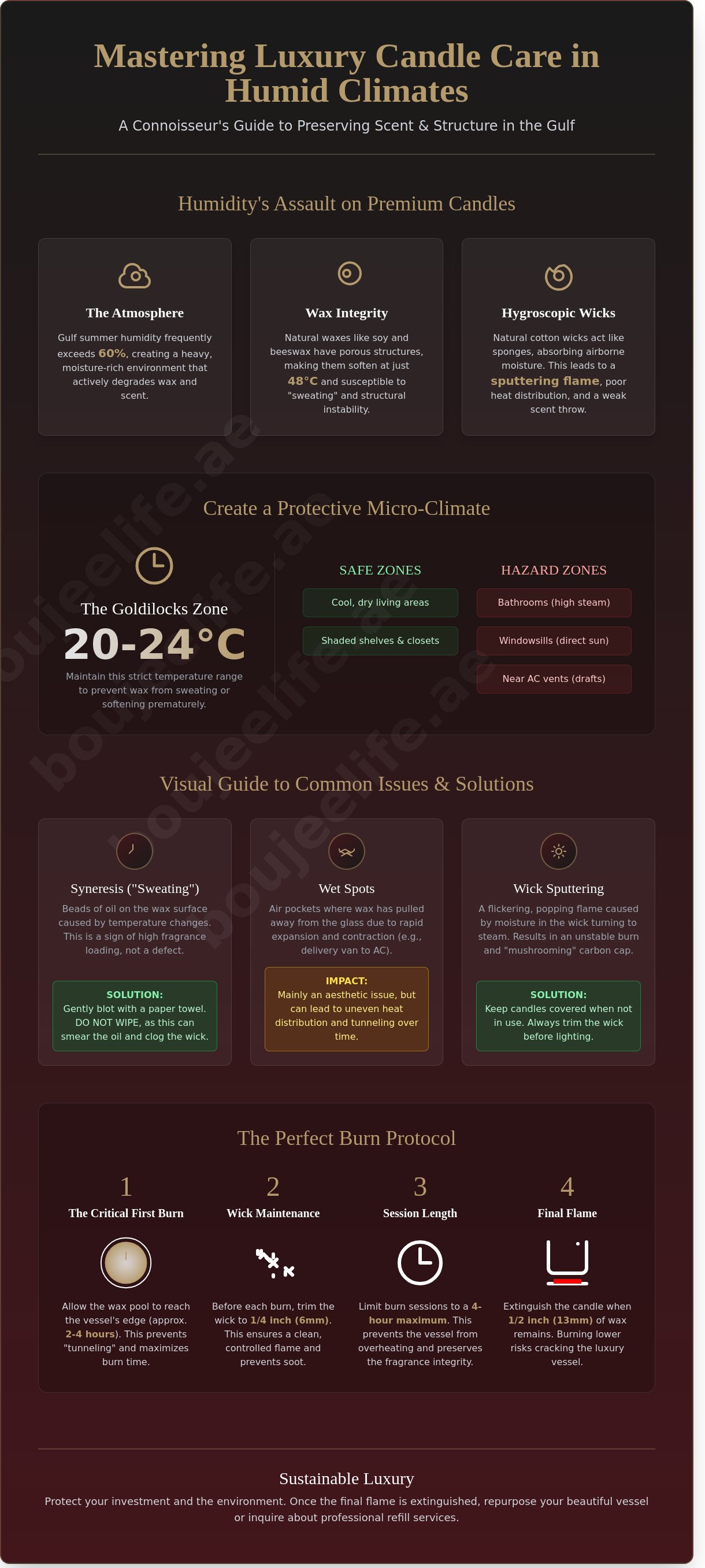
The Dubai summer transforms the atmosphere into a heavy, scent-muffling blanket that challenges even the most sophisticated home fragrances. When the dew point climbs above 22°C, your luxury candle begins a silent struggle against the elements. High humidity levels disrupt the delicate equilibrium of premium natural waxes, which are chosen for their clean burn rather than their ruggedness. Proper candle care in humidity starts with understanding that moisture isn't just on the surface; it's interacting with the candle at a molecular level.
Soy and beeswax blends are particularly vulnerable compared to synthetic paraffin. Natural waxes possess a complex, porous crystalline structure that reacts to environmental shifts. While paraffin is relatively inert, soy wax has a lower melting point, often starting to soften at just 48°C. In the UAE, where outdoor temperatures frequently hit 45°C and indoor humidity can fluctuate, these waxes become structurally unstable. This instability interferes with the molecular release of fragrance oils. Instead of the oils evaporating into a crisp, room-filling "throw," the heavy water vapor in the air traps the scent molecules. This creates a muted or "muddy" olfactory experience that fails to do justice to a premium 400 AED investment. Candle sweating is the natural separation of oils due to atmospheric pressure changes.
Understanding the Hygroscopic Nature of Wicks
Luxury candles almost exclusively utilize 100% cotton or paper-core wicks to ensure a non-toxic burn. However, these natural fibers are inherently thirsty. Through The Science of Scent: How Humidity Affects Premium Wax and Fragrance, we see how materials attract and hold water molecules from the surrounding environment. In the damp Gulf air, a cotton wick acts like a sponge, pulling moisture deep into the braided fibers before you even strike a match.
This leads to the dreaded sputter effect. When the flame hits a moisture-laden wick, the trapped water vapor expands instantly and turns to steam. You'll hear tiny pops and see the flame flicker erratically, which prevents the wax pool from reaching the edges of the vessel. Visual signs of a compromised wick include a "mushroomed" carbon cap that forms faster than usual or a wick that appears limp and difficult to light. Consistent candle care in humidity requires keeping these wicks dry to maintain a steady, clean burn.
Wax Expansion and Contraction in the Gulf Climate
The physical stress on a candle in the UAE is constant. Moving a candle from a 40°C delivery van into a 22°C climate-controlled villa causes the wax to expand and contract rapidly. This movement is most visible through "wet spots," which are actually just areas where the wax has pulled away from the glass vessel due to shrinkage. During high-humidity months, these gaps can collect microscopic layers of condensation, further degrading the wax quality.
- Physical Impact: Rapid cooling causes the wax to pull inward, creating air pockets.
- Scent Throw: Repeated temperature shifts can cause the fragrance oils to migrate to the bottom of the jar.
- Longevity: A candle subjected to constant expansion cycles may lose up to 15% of its total burn time.
Long-term exposure to these fluctuations doesn't just ruin the aesthetic; it fundamentally alters the burn profile. If the wax loses its bond with the glass, the heat distribution becomes uneven. You might find the candle tunneling or the fragrance becoming patchy, with some burns smelling intense and others barely noticeable. Protecting your collection from these shifts is the only way to ensure the 60-hour burn time promised on the label remains a reality.
Strategic Placement: Creating a Micro-Climate for Your Home Fragrance
Your luxury candle is a delicate investment in atmosphere. In the UAE, where outdoor temperatures frequently climb above 45°C, maintaining the integrity of premium wax requires a controlled environment. The Goldilocks Zone for your collection sits strictly between 20°C and 24°C. Deviating from this range risks sweating or softening the wax before you even strike a match. Effective candle care in humidity starts with recognizing that your home isn't a uniform climate; it's a collection of micro-zones that fluctuate with the sun and your cooling system.
Steer clear of the bathroom during the humid summer months. While a flickering flame beside a marble tub sounds like the height of relaxation, the localized steam creates a moisture barrier on the wick. This prevents the fragrance oils from vaporizing correctly and can lead to a sputtering flame. Similarly, the floor-to-ceiling windows of a modern Dubai apartment act as sun-traps. Direct UV exposure can discolor the wax and degrade the expensive perfume oils within hours. Even behind double-glazed glass, the concentrated heat on a console table can reach levels that compromise the scent throw of a high-end pour.
The A/C Dilemma: Airflow vs. Fragrance Stability
Central cooling is a necessity in the Emirates, but direct vent paths are the enemy of a clean burn. Position your candles away from the direct line of A/C blowers. Rapidly moving cold air causes the flame to flicker violently, leading to soot and uneven heat distribution. When cold air hits a hot glass vessel, the wax can shock, leading to hairline fractures or pulling away from the sides of the jar. This phenomenon often results in tunneling, where the center burns down and leaves a ring of wasted wax around the edges. To maintain a steady, iconic glow, use a glass cloche. This serves as a sophisticated barrier against drafts while preserving the concentrated scent profile. The Perfect Burn: Mastering the Wick in Heavy Air provides excellent technical context on how environmental factors influence flame stability.
Ideal Storage Solutions for Your Unlit Collection
Your unlit inventory deserves as much attention as your active display. Open shelving in a bright room is a common mistake that leads to scent evaporation. Interior cupboards, positioned away from external walls, offer the most stable temperature profile. Keep your candles in their original Boujee Life boxes. These containers aren't just for aesthetics; they provide a secondary layer of insulation against humidity fluctuations. Practice a rotation system for your collection every few weeks to ensure each piece remains acclimated to your home's internal climate.
- Store candles in a cool, dark place to prevent UV-induced scent degradation.
- Keep lids tightly secured to lock in fragrance oils and block out ambient moisture.
- Ensure candles are stored upright to prevent wax shifting in warmer temperatures.
Mastering these placement strategies ensures that your home remains a sanctuary of scent, regardless of the soaring humidity outside. If you're looking to expand your curated scent library with pieces designed for the sophisticated Dubai home, you can explore the latest arrivals that define the modern luxury lifestyle.
Managing the 'Sweat': Protecting Fragrance Integrity in the Emirates
Dubai’s summer pushes humidity levels toward 90%, creating a unique challenge for your home’s sensory landscape. You might notice small, glistening beads of oil forming on the surface of your wax. This phenomenon is known as syneresis. While it might look like a flaw, it’s actually a hallmark of a high fragrance load. Luxury candles often contain 10% to 12% fragrance oil; this is the maximum a natural wax blend can hold. When the air becomes saturated with moisture, the wax expands slightly and 'sweats' out these precious oils. Master proper candle care in humidity to ensure these oils return to the wax rather than evaporating into the air.
Don't reach for a heat gun to smooth out the surface. It’s a common mistake that ruins the delicate top notes of complex scents like Sultana or Noctis. High heat flash-evaporates the lighter molecules, such as citrus or light florals, leaving you with a flat, muted fragrance profile. You’ve invested in a premium experience; don't burn it away before you even light the wick. Preserving the integrity of the scent requires a manual, gentle touch that respects the artisanal craftsmanship of the pour.
Step-by-Step Surface Restoration
Grab a clean, lint-free microfiber cloth or a high-quality paper towel. Gently blot the droplets on the surface. Don't rub the wax. Rubbing creates friction and heat, which can mar the smooth, professional finish and push dust into the wax. Once the surface is dry, wait for the humidity to drop, perhaps in the cool of the evening with the AC running at a steady 22°C. This is the ideal time for a restoration burn. Lighting the candle now allows the remaining oils to integrate back into the melt pool, ensuring a consistent scent throw for the life of the candle.
When Sweating Indicates a Quality Issue vs. Environmental Stress
Distinguishing between natural oil separation and a manufacturing defect is simple. If the sweating occurs only during the humid months between May and September in the UAE, it's environmental. High-quality essential oils are more prone to this than cheap synthetic fillers because they are more volatile and reactive to temperature shifts. Controlling the immediate environment is the first step in preservation. The U.S. Environmental Protection Agency suggests that Strategic Placement: Creating a Micro-Climate for Your Home Fragrance is essential for managing indoor moisture. This prevents the ambient air from pulling the oils out of your candle. If a candle sweats in a dry, climate-controlled room at 20°C, it may indicate poor wax-to-oil bonding. However, for most residents in the Emirates, those beads of oil are simply a sign that your candle is packed with the highest possible concentration of luxury fragrance.
- Identify Syneresis: Look for clear or slightly amber beads on the wax surface.
- Blot, Don't Rub: Use a dabbing motion to remove excess moisture without damaging the finish.
- Skip the Heat: Avoid hair dryers or heat guns that destroy top-note integrity.
- Monitor the Climate: Keep your collection in a room with stable dehumidification to maintain candle care in humidity standards.
The Perfect Burn: Mastering the Wick in Heavy Air
In the UAE, where coastal humidity levels frequently surge above 60 percent during the summer months, candle care in humidity requires a tactical shift. The dense, moisture-laden air changes the physics of the flame. It alters how heat rises and how wax cools. Your first burn is the most critical moment for any luxury vessel. You must allow the wax to melt across the entire surface until it reaches the glass edge. This creates a structural memory for the wax. Failure to achieve a full melt pool on the first light leads to a permanent memory ring. In Dubai's heavy air, this initial process often takes longer than the standard sixty minutes. Monitor the vessel closely. Ensure the liquid reaches the perimeter before extinguishing the flame.
Limit your subsequent sessions to three hours maximum. While traditional advice suggests four-hour windows, high humidity softens luxury wax blends prematurely. A shorter burn prevents the wick from drowning in an oversized pool of liquid. Precision is your best defense against soot and uneven heat distribution. Follow the 5mm rule. Trim your wick to exactly 5mm before every single light. A longer wick produces a tall, flickering flame that generates excess carbon in humid conditions. This results in black smoke staining your hand-blown glass. Use a dedicated trimmer for a clean, horizontal cut. Dull scissors often crush the cotton braid, which leads to an uneven, leaning flame that heats one side of the glass more than the other.
Tools of the Trade: Trimmers and Snuffers
Never blow out a candle in a humid environment. Your breath contains concentrated moisture that settles directly onto the hot wick. This makes the cotton difficult to relight and can cause "popping" during the next session. Use a bell snuffer instead. It deprives the flame of oxygen without disturbing the liquid wax. This method traps the smoke inside the bell, preserving the delicate fragrance profile of your room. Keep your trimmer blades sharp. Wipe them with a dry cloth after every use to prevent wax buildup. Clean tools ensure that precise 5mm cut every time, keeping the flame stable and the glass clear.
The Reset Burn: Saving a Tunneling Candle
If your candle begins to tunnel, you must act before the wick becomes submerged. This happens when the center melts faster than the edges, creating a deep crater. You can fix this using the aluminum foil tent method. Wrap a layer of foil around the top of the vessel, folding it over the edges while leaving a small 2cm opening in the center. This reflects heat back onto the stubborn outer wax. Monitor the process every ten minutes. In a room set to a steady 24 degrees Celsius, the edges should liquify and level out within thirty to forty minutes. Once the pool is level, remove the foil carefully with tongs. Always perform this reset on a heat-resistant surface. Avoid leaving the foil on for more than forty-five minutes to prevent the glass from reaching unsafe temperatures.
Maintaining your collection ensures every scent remains as crisp as the day you brought it home. Proper candle care in humidity preserves the integrity of expensive botanical oils. It transforms a simple fragrance into a lasting atmospheric experience. Explore our curated selection of luxury home accents to elevate your living space today.
Beyond the Last Burn: Sustainable Luxury and Professional Refills
The final moments of a luxury candle define the longevity of its vessel. To protect your investment, you must stop the burn when exactly 1cm of wax remains at the bottom. This isn't a suggestion; it's a technical necessity for safety and preservation. As the wax pool thins, the flame's heat transfers directly to the glass base rather than being absorbed by the wax. In the Emirates, where indoor temperatures often fluctuate between intense AC cooling and ambient warmth, this thermal stress can cause even the most durable glass to fracture. Mastering candle care in humidity means knowing when to extinguish the wick to save the jar for its next chapter.
Once the flame is out for the last time, cleaning your vessel becomes a sensory ritual. You can remove the remaining wax by placing the jar in the freezer for two hours, which causes the wax to contract and pop out easily. Alternatively, pouring warm water (not boiling) into the jar can lift the residue. This process preserves the intricate gold leaf or hand-painted details often found on high-end collections. Transitioning your home fragrance strategy is essential as the UAE moves from the heavy humidity of September into the crisp clarity of the winter months. While summer demands citrus and marine notes to cut through the moisture, the cooler season invites deeper ouds and spicy ambers that linger beautifully in the drier air.
The Professional Refill Advantage
Professional refilling is a precise science that accounts for local environmental factors. A standard refill isn't just about pouring wax; it requires calibrating the wax-to-wick ratio to ensure a clean burn in specific climates. Boujee Life provides a meticulous service that matches the wick size to the vessel's diameter, preventing the common issue of tunneling or excessive soot. As the seasons shift in Dubai, you can choose a new scent profile that reflects the outdoor lifestyle. Explore our Professional Candle Refill Service for a seamless experience that breathes new life into your collection.
Repurposing Your Luxury Vessels
Your journey with a Sultana or Sahara jar doesn't end when the wax is gone. These hand-crafted pieces serve as sophisticated accents in a modern interior. Use a cleaned Sultana jar to hold gold-plated stationery on a home office desk, or transform a Sahara vessel into a home for a desert succulent. Choosing to refill rather than replace reduces glass waste by 100% for that specific purchase. It's a conscious choice that aligns with the growing movement toward sustainable luxury in the UAE. By joining this circle of sustainability, you maintain the aesthetic excellence of your home while respecting the environment. It's a sophisticated way to ensure your space remains a sanctuary of fragrance and style year-round.
Maintaining a luxury atmosphere requires attention to detail and a commitment to quality. By following these steps, you ensure that your home fragrance remains as vibrant and clear as a Dubai winter morning. The transition from a finished candle to a repurposed masterpiece is the ultimate hallmark of a refined lifestyle.
Master the Atmosphere of Your Space
Mastering the art of candle care in humidity ensures your chosen fragrances remain as vivid as the day they were poured. By managing wick length and creating climate-controlled micro-climates, you protect the integrity of premium wax blends. The UAE environment, where coastal humidity levels often exceed 60 percent during summer months, demands a specialized approach to home fragrance. Our artisanal UAE-based craftsmanship focuses on these exact conditions. We develop climate-aware fragrance formulations that withstand local atmospheric pressure while maintaining a clean, steady burn. Choosing sustainable luxury doesn't end with the final flame. Our professional refill service allows you to replenish your favorite vessels, effectively reducing glass waste by 100 percent for every reused container. It's about more than just a scent; it's about preserving a moment. Every artisanal pour reflects our commitment to excellence in the Emirates. Trust in a process that understands the science behind the glow.
Invest in a scent experience that honors the unique character of your home. Preserve your home's atmosphere; Explore the full Boujee Life Collection and Refill Services. Your space deserves a fragrance that lingers with purpose and poise.
Frequently Asked Questions
Does burning a candle actually help reduce humidity in a room?
Burning a candle doesn't reduce humidity; it actually adds a small amount of moisture to the air through the combustion process. The chemical reaction of burning wax releases carbon dioxide and water vapor into your living space. While the heat might slightly alter how the air feels, it won't replace a dedicated dehumidifier. In the UAE, where humidity levels often exceed 60 percent, relying on a flame to dry a room is ineffective.
Why does my candle have water droplets on the surface in Dubai?
Those water droplets are known as "sweating," which occurs when fragrance oils and wax separate due to high humidity and temperature fluctuations. In Dubai, the contrast between intense outdoor heat and indoor air conditioning creates the perfect environment for this moisture to form. It doesn't mean your luxury candle is ruined. Simply blot the surface gently with a lint-free cloth before lighting to ensure a clean, even burn.
Can I store my luxury candles in the fridge to stop them from melting?
You shouldn't store luxury candles in the fridge because extreme cold can cause the wax to crack or pull away from the glass. Rapid temperature shifts also degrade delicate fragrance oils, muting the scent profile you've invested in. Instead, find a cool, dark cupboard away from direct sunlight. Maintaining a consistent temperature around 22 degrees Celsius is the gold standard for proper candle care in humidity.
How do I fix a damp wick that won't stay lit?
To fix a damp wick, gently press a dry paper towel against the cotton to absorb excess moisture before attempting to light it. If the wick remains stubborn, use a hair dryer on its lowest, coolest setting for thirty seconds to evaporate any trapped water. A damp wick often sputters or produces a weak flame that won't stay alive. Ensuring the wick is completely dry preserves the integrity of the burn.
Why does my candle smell less strong when it's humid outside?
High humidity levels make the air denser, which physically hinders the dispersion of fragrance molecules throughout your home. When the air is saturated with water vapor, the scent throw feels heavy and localized rather than light and expansive. This is a common challenge for candle care in humidity during the Dubai summer. Using a lid when the candle isn't in use helps keep the wax surface dry and the scent potent.
Is it safe to leave a candle burning while the A/C is on high?
It's safe to burn a candle with the A/C on, provided the flame isn't in the direct path of a vent or draft. Strong air currents cause the flame to flicker violently, leading to uneven melting and unsightly black soot on your expensive glassware. Position your candle in a "dead zone" where the air remains still. This ensures a steady, clean burn that maximizes the life of your wax and keeps the vessel pristine.
How often should I trim the wick during the humid summer months?
Trim your wick to exactly five millimeters before every single burn, regardless of the season or the weather outside. In humid conditions, wicks can absorb moisture and "mushroom," creating a larger, hotter flame that consumes wax too quickly. A precise trim ensures the flame remains controlled and efficient. This simple habit can extend the life of a 250ml candle by several hours, keeping your home fragrant for much longer.
What is the best way to clean a luxury candle jar for refilling?
The most effective way to clean a luxury jar is to place it in a basin of warm, soapy water after removing the bulk of the wax. Avoid pouring boiling water directly into the vessel, as extreme heat can stress and crack high-end glass. Use a soft microfiber cloth to wipe away any remaining residue or soot. This preserves the jar's finish, making it ready for a second life as a stylish vanity organizer or a minimalist vase.

