

You return to your villa after a sunset stroll along the Palm Jumeirah, ready to fill your space with the scent of rare oud or crisp Mediterranean citrus. You light your 450 AED hand-poured candle, expecting a seamless glow, but instead, the flame sinks into a narrow pit, leaving a thick ring of cold, wasted wax clinging to the glass. It's a frustrating sight that ruins the aesthetic of a premium vessel and cuts the fragrance life in half. This phenomenon is known as candle tunneling explained by the science of wax memory and thermal distribution.
We all agree that a luxury fragrance should be an effortless sensory experience, not a source of wasted investment. You deserve to enjoy every hour of that meticulously crafted wax without the shadow of a hollow center. Discover the precise physics behind uneven burning and master the professional techniques required to ensure a perfect edge-to-edge melt every time. This guide covers everything from the critical first burn to the specific restoration methods used by fragrance connoisseurs to bring a tunneled wick back to its original, flawless state.
Key Takeaways
- Get candle tunneling explained through the science of "Wax Memory" and learn why the very first burn dictates the entire lifespan of your luxury fragrance.
- Discover how premium wax blends are specifically engineered to maintain stability in the UAE climate, ensuring a consistent and clean melt.
- Master professional restoration techniques, including the aluminum foil "heat dome" method, to rescue tunneled wax and restore a perfectly level surface.
- Establish essential maintenance rituals, such as precise 5mm wick trimming, to protect your investment and ensure an immersive sensory experience.
- Understand the technical relationship between wick material and heat distribution to achieve a flawless, edge-to-edge pool with every lighting.
What is Candle Tunneling? Understanding the Wax Memory Phenomenon
Imagine lighting a designer fragrance in your Dubai residence. You expect a seamless, golden glow to fill the room. Instead, a deep, narrow hole forms around the wick, leaving the rest of the surface untouched. This is candle tunneling explained. It occurs when the flame only liquefies a small center column of wax, creating a vertical cavity that wastes a significant portion of your investment. You lose hours of burn time, and the aesthetic of a premium vessel is quickly tarnished by stubborn, un-melted residue.
Luxury candles are particularly susceptible to this issue. Many high-end formulations in the UAE market contain fragrance oil concentrations reaching 12% of the total volume. These heavy oil loads change how the wax behaves under heat. Understanding The Science of How a Candle Burns is vital here; the flame must generate enough energy to draw the wax up the wick and vaporize it evenly. If the heat doesn't radiate to the edges of the glass, the candle begins its frustrating downward descent.
The Anatomy of a Tunnel
A tunnel is defined by the "dry" ring of wax left clinging to the perimeter. This wax remains cold and solid while the center sinks deeper into the vessel. This structural failure does more than just look messy. As the cavity deepens, the wick struggles to find enough oxygen to stay lit. Eventually, the surrounding walls of wax may soften and collapse. This liquid flood drowns the flame, making the candle impossible to relight without significant intervention.
The olfactory performance also suffers during tunneling. A candle's scent throw depends on the size of its melt pool. Without a full, edge-to-edge pool of liquid wax, the fragrance oils cannot evaporate effectively into your living space. You're left with a faint, muted aroma rather than the immersive sensory experience you paid for.
Why "Wax Memory" Matters
Wax is a complex crystalline structure with a fascinating quirk called wax memory. When you light a candle for the first time, the wax "remembers" the diameter of its initial melt. If you extinguish the flame before the liquid reaches the vessel walls, you've created a permanent boundary. The wax won't naturally melt beyond that point during your next session. It will simply follow the path of least resistance down the existing hole.
Wax memory serves as a physical blueprint for every future burn, locking in the diameter of the initial melt pool.
Protecting your luxury fragrance requires patience during the first two hours of use. In the UAE's climate, indoor temperatures can influence how quickly the wax softens. Ensure the liquid touches the glass every single time you light it. Treating your home fragrance as a holistic experience ensures that every scent-filled moment remains a perfect memory-making occasion in your home.
The Science of Why Candles Burn Unevenly
Understanding candle tunneling explained through the lens of physics reveals why even the most expensive wax can fail. Thermal conductivity is the silent director of your candle's performance. In premium soy and mineral wax blends, heat travels at specific rates. Soy wax typically possesses a melting point between 49 and 54 degrees Celsius. If the wick diameter is too narrow for the vessel, the radius of the heat pool remains restricted. The flame consumes the center while leaving the outer edges cold and solid.
The relationship between fragrance load and wax stability is equally vital. Luxury candles often feature fragrance concentrations of 10 to 12 percent. While this delivers an immersive sensory experience, it can alter the wax's physical structure. A high oil content often softens the wax, yet it requires a precise wick material to maintain a steady burn. Without this balance, the flame lacks the energy to liquefy the entire surface. This leads to a wasted investment as the wick sinks deeper into a narrow cavern. Relying on verified research from Wax Science shows that fixing these issues requires understanding how heat distributes within glass or ceramic walls.
The Critical First Burn
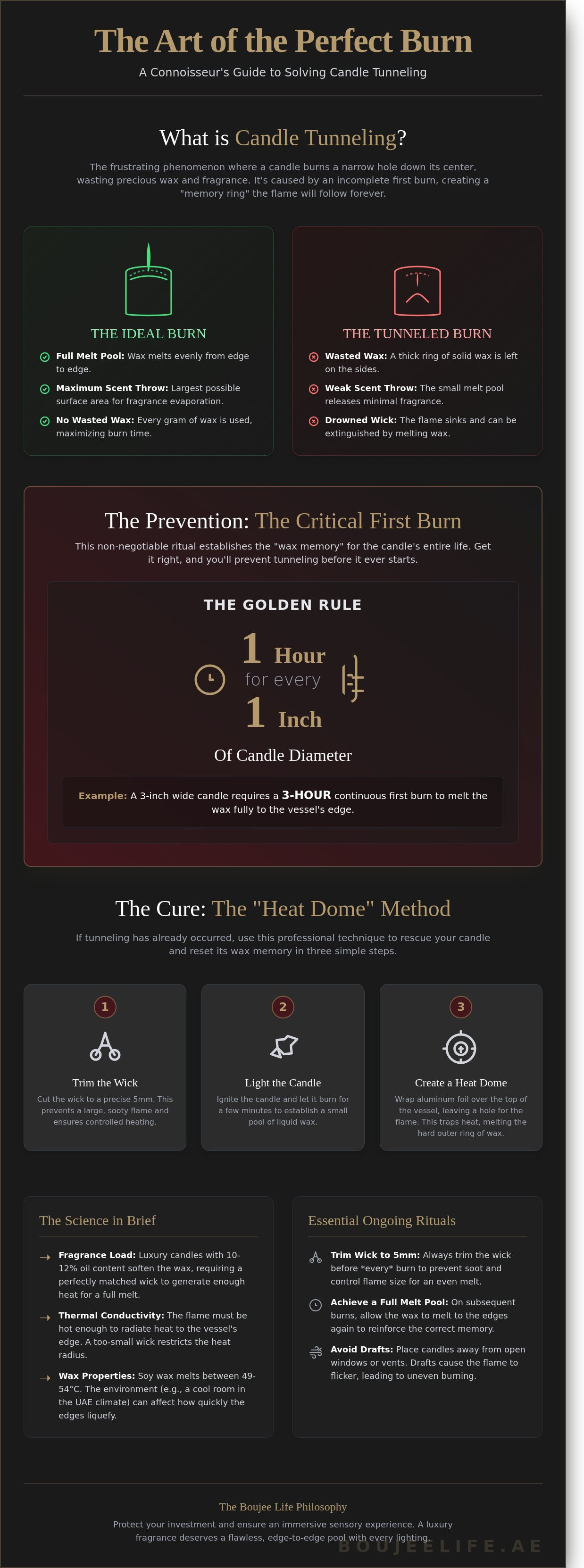
The first burn is a non-negotiable ritual. It establishes the "memory" of the wax. Follow the industry standard: one hour of burn time for every inch of the vessel's width. If your candle is three inches wide, commit to a three-hour session. This allows the heat to reach the perimeter and prevents a permanent narrow path. Don't fall for the "quick burn" trap. Lighting a candle for twenty minutes just for a brief scent creates a shallow pool that the wax won't expand beyond in future uses.
Atmospheric Influence: Drafts and Air Conditioning
Living in the Emirates introduces unique environmental variables. Air conditioning vents in Dubai penthouses or villas create constant, invisible drafts. These currents cause uneven cooling on one side of the vessel. When one side of the glass stays cool, the wax cannot melt symmetrically. Ambient humidity also plays a role. High moisture levels in the air can make the flame dance or flicker, which disrupts the steady heat core needed for a level pool. When you see candle tunneling explained in the context of drafts, it's clear that placement is just as important as the wax quality.
- Keep your candles away from AC vents and open windows.
- Avoid high-traffic areas where walking past creates sudden air movement.
- Ensure the candle sits on a level, heat-resistant surface to keep the wick centered.
Protect your atmosphere. A well-maintained candle ensures your space remains a sanctuary of fragrance. Discover a curated fragrance piece that complements your lifestyle and burns with the precision your home deserves.
How to Fix Candle Tunneling: Restoration Methods for Premium Wax
Having the mechanics of candle tunneling explained allows you to intervene before the damage becomes permanent. Fixing a luxury candle requires patience and precision. If you've found yourself frustrated by a deep ring of wasted wax, you aren't alone. Understanding how Candle Science governs the melt pool helps you regain control over your fragrance investment. These methods restore the flat surface required for a clean, even burn.
The Aluminum Foil Tent Method
The aluminum foil technique is a reliable way to fix an uneven surface. It creates a temporary heat dome that forces the unmelted outer wax to catch up with the center. Wrap a piece of foil around the top of your vessel. Fold it over the edges, leaving a small opening in the center. This opening allows the flame to breathe while trapping radiant heat inside. Light the candle and let it burn for one to two hours. The trapped heat will liquefy the stubborn outer rings, leveling the surface perfectly. Watch the wick closely; it needs to stay centered as the wax softens. Once you have the science of candle tunneling explained through this process, the restoration feels less like a chore and more like a ritual.
Gentle Heat Restoration
For those who prefer a more controlled approach, a hair dryer or heat gun works wonders. Set your tool to the lowest heat setting. Hold it several inches away from the surface. Move the heat in circular motions to melt the high edges. Don't hold the tool too close. You don't want to splash liquid wax onto the wick or the sides of your glass. If the wick becomes submerged, use a paper towel to soak up some of the excess liquid. If the tunnel is exceptionally deep and the wick is buried, it's time to consider professional candle refill services to save the vessel.
When the tunnel is severe, the "Spoon Method" acts as a last resort. Carefully scoop out the hard wax around the edges while the candle is unlit. This lowers the surface level so the wick can breathe during the next burn. Don't throw this wax away. Its fragrance is still potent, making it perfect for use in a wax warmer. This ensures no part of your luxury investment goes to waste.
Safety is paramount during any restoration. Never leave a foil-wrapped candle unattended. The vessel can become significantly hotter than usual due to the trapped heat. If you notice soot buildup or the flame flickering aggressively, extinguish it immediately. A clean, steady burn is the hallmark of the Boujee Life experience. By maintaining the integrity of the wax, you ensure your home remains a sanctuary of sophisticated scent.
Preventative Rituals: Ensuring a Perfect Edge-to-Edge Burn
The first lighting of a luxury candle is a commitment to its entire lifespan. To avoid the frustration of wasted wax, having candle tunneling explained through the lens of physics is essential. It starts with the wick. Precision is your best tool. Always trim the cotton or wood to exactly 5mm before every lighting. A long wick creates an unstable, oversized flame that consumes wax too quickly and generates unnecessary soot.
Visual inspection is your primary maintenance task. Look for "mushrooming" at the tip of the wick. This carbon buildup causes the flame to flicker and produce uneven heat, which often leads to a jagged melt pool. Use a professional trimmer to remove this before the debris falls into the liquid wax.
Preserving the integrity of the wax requires the right accessories. A snuffer prevents hot wax from splattering, while a wick dipper is the preferred choice for those who want to eliminate smoke entirely. By dipping the lit wick into the liquid pool and straightening it immediately, you coat the wick in fresh wax. This prepares it for a seamless start during your next session.
- Trim wicks to 5mm to control flame height.
- Remove carbon mushrooms to ensure clean combustion.
- Use a wick dipper to eliminate post-extinguish smoke.
- Center the wick while the wax is still fluid.
Calculating Your Burn Time
Patience is the secret to a flawless surface. As a general rule, allow one hour of burn time for every inch of the vessel's diameter. Larger investments, like the Sultana series, possess a wider surface area that demands a longer initial commitment. If you extinguish the flame before the liquid reaches the glass edges, you've essentially "memorized" a smaller circle into the wax. This mistake is how tunneling begins. Create a routine that respects this slow-release process to fully experience the fragrance layers.
Wick Grooming and Placement
A leaning wick is a silent catalyst for lopsided melting. If the flame sits closer to one side, that side will liquefy while the other remains a cold, hard cliff. While the wax is still warm and fluid after a session, use a metal tool to gently nudge the wick back to the center. This ensures heat distribution remains symmetrical for your next burn. This level of care is essential when practicing scent scaping, where the purity of the fragrance and the visual aesthetic of the flame must work in harmony. Proper grooming prevents candle tunneling explained in your maintenance logs from ever becoming a recurring issue.
Experience the art of a perfect burn with our curated scents. Explore the collection now.
The Boujee Life Philosophy on Sustainable Fragrance
Living in the United Arab Emirates requires an appreciation for how environment dictates behavior. The transition from the outdoor heat to the precisely controlled humidity of a Dubai villa affects how luxury wax sets and throws scent. We engineer our curated wax blends to remain stable within these specific atmospheric shifts. When you understand the science behind candle tunneling explained in this guide, you recognize that a candle isn't just a decor piece; it's a technical achievement. Our formulations prioritize a higher melting point to ensure the surface remains level even when the air conditioning is humming in the background.
Mindful candle care transforms a simple task into a grounding ritual. It's a moment to pause and reset the energy of a room. By following proper burn protocols, you aren't just maintaining a product; you're preserving a sensory experience that defines your home. This commitment to care reflects a broader shift toward intentional living, where the quality of the atmosphere is as important as the architecture itself.
Quality Components and Burn Consistency
The architecture of the vessel plays a vital role in the life of the fragrance. High-end series like our Romanesque or Sahara collections utilize dense materials that aid in heat retention. These heavy-walled vessels act as insulators, keeping the wax near the edges warm enough to melt completely. This structural advantage is a primary defense against the stubborn wax rings that plague thinner, mass-produced jars.
Precision defines our artisanal process. We conduct rigorous testing to ensure every wick size perfectly matches the specific viscosity of our fragrance oils. A wick that's too small won't generate enough heat, while one that's too large creates a dangerous flame. Premium ingredients like high-density soy and mineral waxes ensure a uniform melt rate, which significantly reduces the likelihood of tunneling during the first burn. This meticulous calibration ensures that the flame remains steady and the wax pool reaches the edge every time.
The Refill Revolution
Luxury shouldn't be disposable. Our refill service is designed for those who appreciate the lasting value of an iconic vessel. Instead of discarding a beautiful Romanesque jar once the wax is gone, you can choose to have it expertly replenished. This model allows you to reuse these handcrafted pieces indefinitely, reducing waste without compromising on a sophisticated home aesthetic that evolves with your taste.
Professional replenishment offers a distinct advantage over DIY kits. When a candle is refilled by experts, the wick is centered with industrial precision and the wax is poured at the exact temperature needed to bond with the existing vessel walls. This attention to detail prevents the structural weaknesses that often lead to uneven burning later on. It's a seamless way to maintain a fragrant home while honoring a commitment to sustainable, high-quality craftsmanship. You keep the beauty of the original piece while enjoying a fresh, flawless burn.
Mastering the Art of the Perfect Burn
Your luxury candles are an atmospheric investment in your home's sensory identity. Mastering the initial burn ensures the wax memory sets a consistent edge to edge pool every time you light the wick. If you encounter an uneven dip, techniques like the foil method or gentle heat application level the surface without compromising the delicate fragrance oils. Now that you've had candle tunneling explained, you possess the knowledge to protect the longevity of your most cherished scents. It's about more than just light; it's about preserving the integrity of the fragrance for its entire lifespan.
We believe in a circular approach to luxury within the United Arab Emirates. Our artisanal UAE-crafted wax blends are poured to deliver a clean throw that fills your space with sophisticated notes. Whether you're captivated by the deep allure of Noctis or the regal warmth of Sultana, each vessel is a functional masterpiece. Our professional sustainable refill service ensures your favorite jars remain a permanent part of your decor. This commitment to sustainability allows you to enjoy world-class scents while reducing waste in a meaningful way.
Explore our curated collection of artisanal scents and refill services
Embrace the ritual of a flawless burn and let your home tell a story of refined elegance.
Frequently Asked Questions
Is a tunneling candle permanently ruined?
No, a tunneling candle isn't a lost cause. You can restore the surface by applying the foil method, which reflects heat back to the outer edges of the jar. This process melts the stubborn wax ring and levels the pool within thirty minutes. For a luxury fragrance investment, taking a few moments to fix the burn ensures you enjoy every hour of the scent profile you purchased.
How long should I burn my candle the first time I light it?
You should burn your candle for approximately two to four hours during the first lighting. This allows the wax to melt completely across the diameter to the glass edge. Since wax has a memory, skipping this step leads to the issue of candle tunneling explained in our guide. Ensuring a full melt pool on day one prevents wasted wax and keeps the surface pristine for future sessions.
Can I use a hair dryer to fix a tunnel in my candle?
Yes, a hair dryer on a low, warm setting is an effective tool for smoothing out uneven wax. Hold the dryer at least 15 centimeters away to avoid splashing liquid wax or damaging the integrity of the wick. Gently heat the high edges until they melt and join the central pool. This creates a fresh, level surface that allows for a seamless burn the next time you light it.
Why does my candle have a hole in the middle but wax on the sides?
This phenomenon occurs when the candle is extinguished before the heat reaches the outer perimeter of the vessel. The wick only melts a small circle in the center, which then hardens into a narrow track. During the next light, the flame follows that existing path downward rather than outward. It's a common issue that often stems from a rushed initial burn or an undersized wick for the jar's diameter.
Does the type of wax affect how likely it is to tunnel?
The composition of the wax significantly impacts burn behavior. Natural waxes like soy and beeswax have higher melting points and stronger memory tendencies compared to traditional paraffin blends. In the UAE climate, where indoor air conditioning is constant, these dense waxes require more patience to reach the edges. Choosing a high quality blend designed for consistent heat distribution helps maintain a clean, even burn.
How do I stop my candle from tunneling in a drafty room?
Move your candle away from AC vents, open windows, or high traffic corridors to ensure a steady flame. Drafts cause the flame to flicker and lose heat, which prevents the wax from reaching its necessary melting temperature at the edges. If you can't move the candle, use a decorative glass hurricane or a specialized candle topper to shield the flame from air currents. This keeps the heat concentrated where it's needed most.

